
Aerosure · Technician range
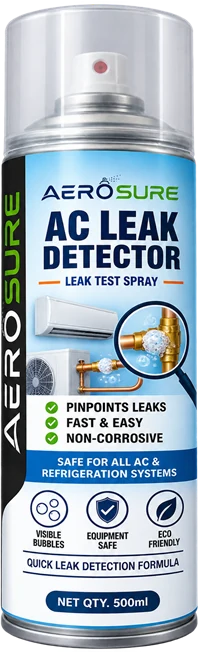
Aerosure AC Leak Detector 500 mL: find gas leaks before recharge
Aerosure AC Leak Detector is a 500 mL spray that forms bubbles where refrigerant escapes. Spray it on flare nuts, brazed joints, valves and U-bends of a pressurised system and watch for growing bubbles. Fix the leak before you recharge AC gas, so the customer does not call you back for a repeat recharge.
- DPIIT recognised · DIPP258886
- ISO 9001:2015
- GMP (IAF)
- Own aerosol filling line
- MSDS on request · CoA with every batch
What are the Aerosure AC Leak Detector 500 mL specifications?
| Volume | 500 mL aerosol |
|---|---|
| Use on | Flare nuts, brazed joints, service valves, U-bends |
| Method | Bubble test on a pressurised system |
| After use | Wipe off as stated on the label |
| Documents | SDS on request |
Coverage per can, pH and shelf life are on the label and SDS. Ask us for the SDS.
How do you use Aerosure AC Leak Detector 500 mL?
- Pressurise. Make sure the system is under pressure.
- Clean. Clean the joint to be tested.
- Spray. Spray Aerosure AC Leak Detector on the joint.
- Watch. Watch for growing bubbles that mark the leak, then repair and re-test.
Full guide with photos and sources: How to find an AC gas leak before recharging.
Technician tips
- Test while the system holds pressure.
- Clean the joint first, so dirt does not hide bubbles.
- Give each joint time: slow leaks make small bubbles.
- Mark every leak before you start repairs.
Safety
Read the label and SDS before use. Wear gloves and eye protection. Keep sprays away from heat and flame, and off live electrical parts.
Which jobs is it for?
Where can you buy it?
Technicians, AMC companies and service networks buy direct at trade prices. Distributors get territory margins.
Reviews
We publish only genuine, verified buyer reviews. None are listed yet.
What mistakes should you avoid with Aerosure AC Leak Detector 500 mL?
- Spraying with the power still on.
- Cleaning the coil but not the filter, drain tray and blower wheel.
- Rinsing with a high-pressure jet that bends the fins.
- Skipping the rinse, so loosened dirt dries back on the coil.
How do you check the clean worked?
- Airflow at the grille is strong and even.
- The drain runs clear and the tray is empty after a test run.
- The musty smell has gone after the first cooling cycle.
- The customer sees a clean filter and coil before you close the panel.
How should you store and handle Aerosure AC Leak Detector 500 mL?
- Aerosol cans are pressurised: keep away from heat, sparks and open flame, and never puncture or burn a can, even when empty.
- Work only with the power isolated and keep sprays off live electrical parts.
- Wear gloves and eye protection, and store cans upright below 50 °C, out of direct sun.
- Read the SDS before first use and keep it where the product is used.
What should you tell us for a quote on Aerosure AC Leak Detector 500 mL?
- How many units you service in a month and your city
- Indoor or outdoor coils, and whether sites are coastal, industrial or inland
- Cans per month, or cases if you buy for a team
- Whether you want trade pricing or distributor terms
We reply within one working day with a price, the SDS and TDS, and a suggested dose to validate on site.
Aerosure AC Leak Detector 500 mL: quick answers
How do you find an AC gas leak?
Pressurise the system, spray Aerosure AC Leak Detector on each joint and watch for bubbles that grow. Check flare nuts, brazed joints, service valves and U-bends first.
Why find the leak before recharging?
Gas added to a leaking system escapes again. The customer pays twice and the AC stops cooling again.
Where do split ACs usually leak?
Most often at flare nuts, brazed joints and the U-bends of the coil. Pinholes from formicary corrosion are another cause.
Stock Aerosure for your service team
Trade pricing on cases, delivered across India. We reply within one working day.
AC maintenance numbers to know
| What | Typical range |
|---|---|
| Clean or replace filters | Every 1 to 2 months in the cooling season, sooner in dust [source] |
| Energy saved by a clean filter | 5% to 15% less energy than with a clogged filter [source] |
| Check the indoor (evaporator) coil | Every 12 months; clean when dirty [source] |
| Drain line | Clear it at each service so water cannot back up [source] |
| Star label | Compare models by BEE star rating and ISEER [source] |